

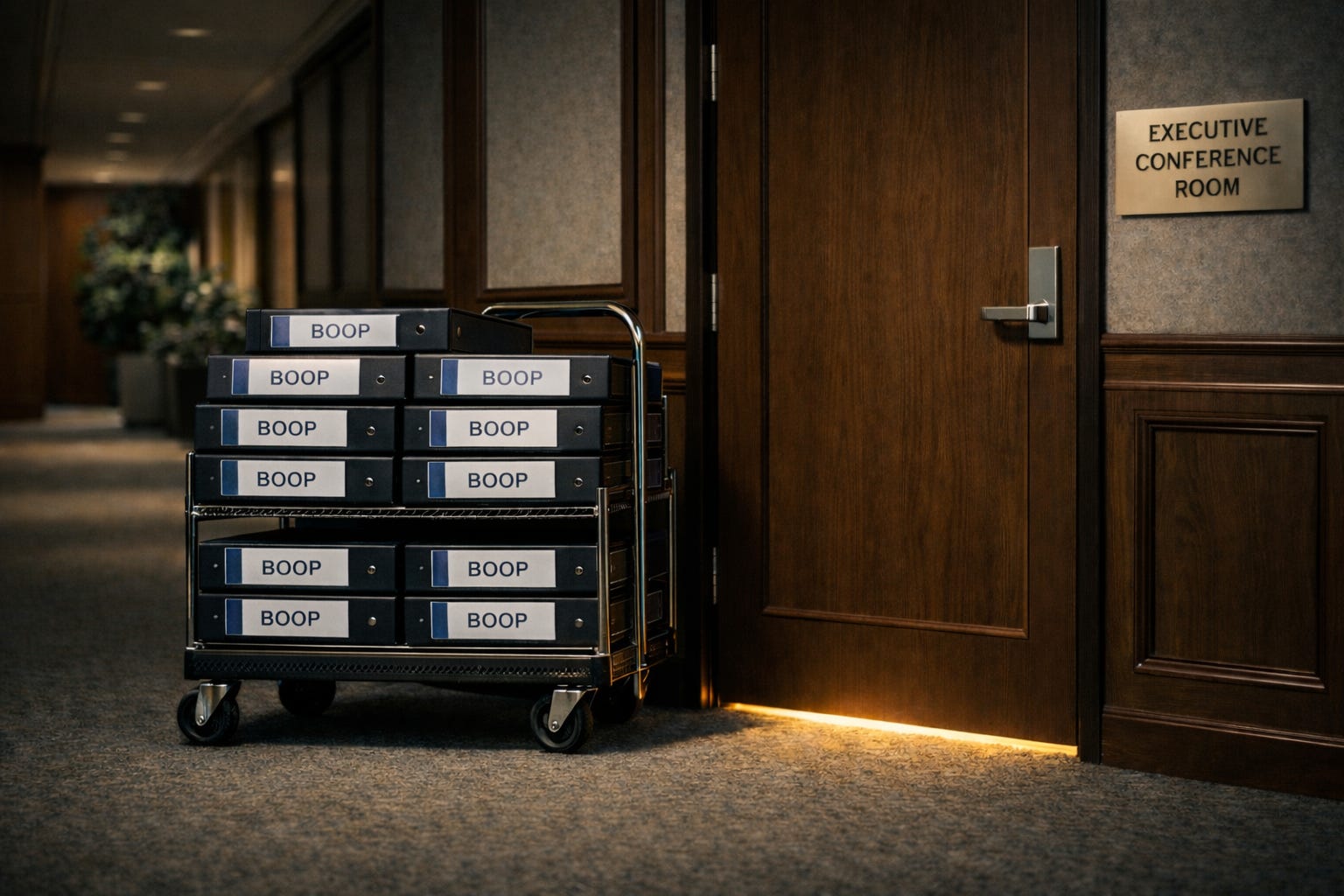
There was a moment after I took my big corporate job at Microsoft that I realized there was something beyond money. It was one early morning when I was carting a stack of large three-ring binders to a conference room. On the other side of that door was Bill and the Office of the President (BOOP). My manager met me outside to accept the binders I had spent the previous night assembling in the campus copy center. My manager then said, “Do you want to come in and listen?” I said, “Sure.” What transpired from that point, I’ll never forget.
I was a fly on the wall. I looked around the room and I saw all the other flies. This was a meeting of who's who in the company and a gathering that set the future direction for the next year and beyond. In the center of this room was a big conference table. There were Bill Gates, Mike Maples, Steve Ballmer, and Frank Gaudette, and all the other lieutenants of that day. I was nervous, fascinated, and curious.
Two levels away was the man who ran the Enterprise Customer Unit, or ECU. He was at the table. Let’s call him John. John was the coolest cat that I’d ever seen. So many of us were in our thirties, but this guy may have been in his late fifties, early sixties. I’d seen him at conferences, sales meetings, and customer pitches. This guy was smooth.
As I was holding up the wall, I looked over and it was John’s turn to duel with Bill. Standing there, I felt really good, considering all the work that I had done compiling the data for our customer unit, preparing it, and getting it there on time. Doing an all-nighter was a badge of honor in those days. I helped hand out the binders and then the questioning began. To my dismay, the binders weren’t even opened. Here was Bill with one question after another about deep nuances of the ECU. Everyone at that table was extremely bright and it wasn’t about how much you knew. It was about seeing through the data to have actionable insights and almost predict the future. Bill was playing chess. I glanced at John, and there was a bead of sweat on his forehead. This guy was the smoothest I knew and somehow, he was nervous.
I had to think about that for a while. I’m looking at a table that has a combined net worth of billions of dollars. And this was in the mid-90s. I thought to myself, “What’s going on here?” It was like a beam of light that came in. In that moment, I realized this had nothing to do with money. You couldn’t buy a seat at this table. And it was the only seat to have at this time in the industry.
Something that was more than money — a concept I hadn’t yet considered. What does life look like beyond money? And what if it’s not about money?
For the group at that table, it was a little bit about money, but way more about power and control. I had mixed emotions about this. You mean it’s just not about working hard, doing your best, and being recognized for what you’ve done? I’ve got to consider things like power, influence, and control to get ahead in my vocation. Something was not adding up. I didn’t have language for it yet, but what I was watching was the system working exactly as designed — for the people already at the table.
I also thought a lot about safety and security. If any one of those people at the table left the company, they’d have a pretty big nest egg to be able to take and have a cushion to do something else with. Not so much for me. I had my fair share, but there were vesting schedules. Each time a grant occurred, it added another four years. I can’t tell you how many people had spreadsheets and looked at their vesting schedules quarter after quarter trying to figure out what their exit strategy would be once they got to their self-prescribed milestone. Everyone knew we couldn’t continue at the pace we were keeping. And who wanted to be someone that wasn’t on the fast track, who took some normal job inside the company and sat quietly vesting? Well, I certainly didn’t want to be that person, and it was the biggest monetary mistake of my life as I left in a fit of anger, six months after taking this job. I made it almost eight years and I was relieved to be out of there.
For years after, I looked at my vesting spreadsheet and what could have been. The millions, then tens of millions of dollars, staring me right in the face. In today’s terms, more than a hundred million. It ate at me, and the anger grew. A year later after quiting, I tried to get a field job back, along with my prior stock option grants, but at that point it was too late. I realized I was chasing the past.
As I was climbing the corporate ladder at Microsoft, the makeup of the people who were hired changed. They were a bit older and had solid experiences in the industry. When I looked in their eyes, they knew the kind of opportunity ahead of them and they were very grateful for it. I told my friends all sorts of stories about the company’s coming demise. I didn’t realize it was just a reflection of what was going on inside me. I was scared, confused, and angry. I didn’t have the business maturity to understand what I had in my hand. And my actions showed it.
I look back now and I’m grateful for the experience because at that time I wasn’t ready for that type of money. I think it would have fed my self-centered, egotistical, and materialistic tendencies and turned me deeper against myself. Something I wouldn’t start to address until many years later.
Loved your storytelling in this piece. Found myself craving more of your inner world and experience as you navigated those rooms.